Monday, January 25, 2021

World Handicap System's Stroke Allocation Method: Part I


The World Handicap System (WHS) proscribes a new method for determining how handicap strokes are allocated among holes.  Appendix E of the Rules of Golf states that each hole should be ranked by playing difficulty.  Hole difficulty is defined by:

              Hole Difficulty = Stroke Value + Bogey Value – 2 x Par

The Rules of Golf, however, does not define Stroke or Bogey Values or give any indication on how they are to be estimated.  It does say these values “can be determined objectively using hole-by-hole data from the Course Rating Procedure”.  Part II will examine if this assertion has any validity. 

The WHS removes the stroke allocation analysis from the club’s handicap committee and places it with the regional golf association (i.e., from those to regularly play the course to those who walk the course once every five years.  Part I examines the work of the Southern California Golf Association (SCGA) as a test of whether the switch to a regional association made for any improvement in the allocation process.  The SCGA prepared a Stroke Index Progression Report (5/18/2020) for two courses.[i]  The errors and inconsistencies in the report indicate removing the analysis from the handicap committee was problematical.  The troubling difficulties with the report are detailed below:

1. Mistake in Assigning Hole Difficulty - As shown in Table 1, the SCGA assigned different difficulties to the exact same tees.  For example, on hole 1 of Course 1 the tournament tees are the black tees, yet the Report shows different difficulties.  These errors do not affect the results but do indicate a lack of care in preparing the report.  A handicap committee would be familiar with the course and not make such a basic error.

Table 1

Hole Difficulty Errors 

Course

Hole

Tee

Difficulty

Tee

Difficulty

Course 1

1

Black

1.28

Tournament

1.24

Course 1

18

Tournament

0.77

White

0.80

Course 2

1

Black

1.53

Tournament

1.50

Course 2

2

Black

0.51

Tournament

0.41*

Course 2

18

Black

1.68

Tournament

1.64


* The difficulty was .51 on the Tournament Tee rating but was entered as .41 on the summary sheet.


2. The Weighted Hole Difficulties Are in Error - The report only shows the hole difficulty for four sets of tees.  When the hole difficulties are weighted by the number of rounds played, the results for the Course 2 differ from those shown in the report.  Table 2 below gives an example for hole 3 on the Course 2.

Table 2

Weighted Hole Difficulty 

Tee

Report Difficulty(D)

Number of Rounds(R)

Weighted Avg. D*R/8934

Black

0.48

1146

.06

Tournament

0.48

2838

.15

White

0.48

3549

.19

Green

0.27

1401

.04


Weighted Difficulty

.44


The weighted average is .44 and not .32 shown in the report.  Since the weighted hole difficulties for the Course 1 are correct, there must have been computational errors in the Course 2 calculations.  Why did not the SCGA double check its calculations?  Probably because it has to turn out hundreds of such reports and knew the recipient clubs would not the report’s accuracy.   It is doubtful that handicap committees concerned with only one course would be so cavalier, but that remains to be tested.

3. Inconsistencies in Course Rating Estimates - The sum of the Scratch Values should equal the Course Rating.  The sum of the Bogey Values should equal the Bogey Rating.  Then an equation for the Course Rating would be:


Eq. 1   Course Rating = ((2 x Par) + HD - Slope Rating/5.381)/2

Where,

                             HD = Hole Difficulty summed over all holes

The report provided hole difficulty for two courses with four sets of tees.  Table 3 shows the Course Rating as calculated by Eq. 1 and the SCGA Course Rating.

Table 3

Course Ratings


Course

Rating

Course 1

Black

Course 1

Tourn.

Course 1

White

Course 1

 Green

Course 2

Black

Course 2

Tourn.

Course 2

White

Course 2

 Green

Eq. 1

71.6

70.3

69.3

67.5

71.5

70.4

68.5

65.8

SCGA

71.0

69.6

68.7

66.9

71.2

70.0

68.4

65.7

Difference

0.6

.07

0.6

0.6

0.3

.04

0.1

0.1


Eq. 1 always overestimates the SCGA Course Rating.  The difference in Course Ratings at Course 2 could be due to rounding errors.  The differences at Course are too large to be explained by rounding.  The hole difficulties would have to be reduced by 1.2 strokes to eliminate the difference.  The inconsistencies in Course Ratings between the two methods may indicate Course Ratings are not the sum of hole ratings. If that is the case, the accuracy of the Scratch and Bogey Values are brought into question.

4. Incorrect Distance Measurements – The SCGA has rated the courses based on the yardages shown on the card.  Many of those yardages are in error due to the way the courses are setup.  The most egregious example is hole 5 of the Course 2.  The green tees are set alongside the red tees and not the white tees as specified on the card.   The misplacement of tees leads to errors in both the Course Ratings and anomalies in the stroke allocation (e.g., the relatively benign Hole 5 on the Course 2 is rated more difficult than Hole 2 where a hard green is surrounded by sand and water).   A handicap committee would be aware of the course set-up and would not make the same mistake.   


Conclusions on the efficacy of the WHS’s method cannot be drawn from a single example.  The example does support the contention Handicap Committees are better suited to doing the stroke allocation analysis because of their familiarity with the course and a greater sense of responsibility to doing it right.  It is likely, however, the analysis will remain in the hands of golf associations.  The WHS recommended method relieves the handicap committee from the arduous task of collecting scorecards and analyzing hole-by-hole scores.  Many committees will adopt this easier road believing the regional golf association cannot be wrong and if there is the blame it will be placed on the association and not us.   Part II will examine the accuracy of the WHS method and determine if there is another reason not to cede control of the stroke allocation process to the regional association.     


[i] Stroke Index is a new term introduced in the WHS.  Formerly, the USGA simply referenced the “The Allocation of Handicap Strokes.”  Other golf associations (Golf Australia and the Council of National Golf Unions) did use the term “Stroke Index.”  However, the Stroke Index is not an index.   Its use is both wrong and confusing with the more prominent Handicap Index. 

Tuesday, November 10, 2020

The Southern California Golf Association and Kevin O'Connor Can Do Better


A previous post (The World Handicap System Penalizes the Honest Player, July 21, 2020) discussed how the exceptional score reduction in Rule 5.9 of the World Handicap System (WHS) was unfair to the honest player.  The intentions behind the adoption of Rule 5.9 were good but misguided.  The WHS eliminated Section 10-3 of the USGA Handicap System that reduced a player’s Handicap Index for exceptional tournament scores.    While the USGA’s Section 10-3 was not effective, it was at least an attempt to ensnare the unethical player. 

The WHS needed something to replace the USGA’s efforts and thus Rule 5-9 was born.  Rule 5.9 differed from the old Section 10-3 in three important respects.  First, exceptional performance was no longer limited to tournament rounds. All rounds would be examined.  Second, only one exceptional round was required for an Index reduction.  Section 10-3 required two exceptional rounds.  Third the definition of what constituted an exceptional round was drastically changed.  Rule 5-9 requires a differential at least 7.0. below a player’s Index to be counted as “exceptional.”  Section 10-3 counted differentials of at least 3.0 below a player’s Index as “exceptional.” Neither attempt at controlling the unethical player was likely to be effective.  But that was not the point.  Rule 5-9 would give the illusion of cracking down on sandbaggers even though it was practically toothless. This is just another example of bureaucracies confusing motion with progress. 

When the WHS was announced, there was no defense of Rule 5.9.  That was wise since no reasonable defense exists.  That did not dissuade Kevin O’Connor, Director of Member Services at the Southern California Golf Association (SCGA), from trying to construct such a defense.  O’Connor was once Director of Handicapping at the USGA.  He has administered the handicap services of the SCGA since 2012.   You would think O’Connor would write with intelligence and insight on handicap issues given his experience.  Unfortunately, that is not the case.

O’Connor wrote an article on Rule 5.9 for the fall edition of Fore, the SCGA’s magazine.  His article exhibits three basic errors shown below in italics:

1.                   Part of the rationale for a reduction is research showing that someone doing this well (having a score differential 7.0 better than his Handicap Index) is likely to do so again in the future and this indicates the Handicap Index isn’t reflective of the player’s demonstrated ability.

Debaters without a good argument for their case often will resort to “experts say,” or as in this case “research proves” my position.   Somehow the experts are never identified, or the research cited.  This is because there is no research backing O’Connor’s claim.  The research that is available shows Rule 5.9 is both discriminatory and of little value.  It is discriminatory  according to the USGA research since high handicap players are 21 times more likely to have an exceptional score reduction than a low-handicap player.[1]  It is of little value because that same research indicates the rarity of such exceptional scores.   A midrange Index player has .003 chance of scoring a differential 7.0 or better than his Index.[2]   

2.                   The reduction makes the Handicap Index more statistically accurate.

The use of the term “statistically” is O’Connor’s attempt to indicate a highly sophisticated analysis behind Rule 5.9 where there is none.   Accuracy of a player’s Handicap Index is measured by the error in predicting a player’s next differential.  Arbitrary cut-offs for reductions in Rule 5.9 lead to decreasing rather than increasing accuracy.  For example, assume two players have the same Handicap Index.  In the next round, one player has a differential 7.0 below his Handicap Index while the other player has a differential 6.9 below his Handicap Index.   The penalized player gets a reduction of 1-2 strokes more than the unpenalized player.  The WHS generates Handicap Indexes that cannot be accurate (or equitable) for both players.

3.                   Scores posted after an Exceptional Score Reduction has been applied are not impacted.

While technically correct, O’Connor fails to mention a player’s Handicap Index can be affected long after an additional 20 scores are added to his scoring record.  For example, assume a player has a 16.0 Handicap Index and an Exceptional Score Reduction reduces his Index to 13.0 which is now his Low Index of the year.  If the exceptional score is an anomaly, the player’s Index will revert to 16.0.   Under Rule 5.8, any increase of 3.0 or more in his Index will be reduced by 50 percent and his Index will be capped at 18.0.  Such restraints on the player’s Index will last until the anniversary of his exceptional round.  


O’Connor ends by arguing Rule 5-9 “protects all players in relation to one another and results in a better Handicap Index more indicative of a player’s demonstrated ability.”  The examples above prove this statement is not true.[3]  O’Connor and the SCGA should educate and not indoctrinate golfers on the workings of the WHS.   Misleading articles such as O’Connor's weaken the credibility of the SCGA.  Both the SCGA and O’Connor can and should do better.


[1]  The USGA Handicap System 2016-2017, Appendix E.  A player if an index between 0-4.9 has a 1 in 2837 chance of having a net differential of 7.0 or better. A player with a 30.0 Handicap Index has a 1 in 133 chance.

[2] Ibid.

[3] The SCGA’s record in explaining the handicap system is not a good one. See “Southern California Golf Association Errs Badly,” ongolfhandicaps.com, May 10, 2017.

Saturday, October 31, 2020

World Handicap System - Clean-up on Rule 5.8

The World Handicap System (WHS) has been in effect for about a year.  If the WHS was a product, the manufacturer would be examining if it made handicaps more equitable, more accurate, and easier to use.  If history is any guide, golf's governing bodies are not making such an effort. Without the data within GHIN, independent analysis of the WHS cannot be undertaken.  It is possible, however, to theorize about the efficacy of any Rule.  This post examines Rule 5-8 Limit on the Upward Movement of a Handicap Index.  It recommends eliminating the Soft Cap  and adopting a simple  Hard Cap.  If the Soft Cap is to be kept, editorial changes are suggested to make the it more understandable and transparent.    

Eliminating the Soft Cap - Rule 5-8 limits the upward movement of a Handicap Index by employing Soft and Hard Caps.  The Soft Cap is triggered when a player’s calculated Handicap Index is 3.0 or more above his Low Index of the year.  The value above 3.0 is restricted to 50% of the increase.  There does not appear to be empirical evidence justifying the Soft Cap.  The adoption of this Soft Cap was probably based on two reasons.  First, it made the WHS complicated and to many players it would imply validity.  Second, since the WHS eliminated any handicap controls based on tournament performance,  the Soft could be defended as the WHS effort in controlling sandbagging. Neither argument is convincing. 

The Soft Cap would not be an effective instrument in controlling sandbagging..  The astute sandbagger  knows how to maintain his Low Index and will not let it drop due to a series of good scores. The Soft Cap, however, can ensnare the honest player.   Relatively modest increases (a region between +3.0 and +4.0) in a player's Index can be caused by random variations in scoring, slumps, changes in playing conditions (e.g. summer versus winter), and by a player manipulating his scores.  Anecdotal evidence suggests, a large percentage of Soft Cap reductions in this region are due to causes that should not be penalized.  Therefore, the Soft Cap will ensnare the honest player  and not advance the equity of competition.

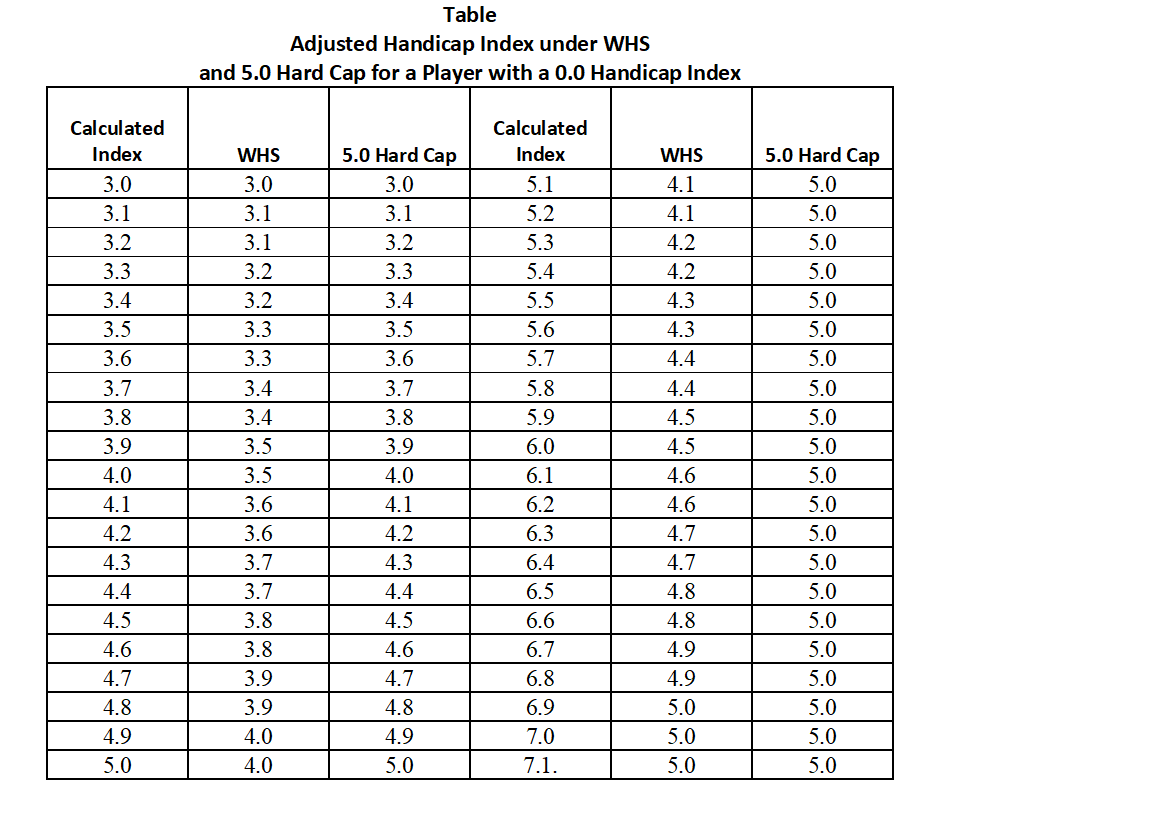
The Table below shows a player's reduced Index under the WHS compared to only having a hard cap of 5.0.  There are two regions of interest.  For increases in Index between 3.0 and 4.0 there is only a minimal effect on a players handicap-- zero to one-stroke.  This is the rregion where the honest play will most likely to be penalized.  Adopting the 5.0 Hard Cap would eliminate this inequity.   

For increases in Index from 5.0 and on up, a Hard Cap of 5.0 leads to a slightly smaller reduction than the application of the Soft Cap.  For example if a player had a calculated Index increase of 6.0 the difference between the Soft Cap and Hard Cap reduction would only be 0.5. That is the Hard Cap is almost a severe a penalty on those players most likely to be manipulating their Index.  In essence, the Soft Cap under Rule 5-8 can be replaced by a simple Hard Cap of 5.0 with no significant effect on equity.

Under the Soft Cap a player can have an increased Index of 7. before reaching the Hard Cap comes into play.  Statistically such an  increase is so rare it should come to the attention of the Handicap Committee.  This was done under the old Golf Australia Handicap System.  That system  had a 5.0 Hard Cap, but it was but the authority to impose the Hard Cap was given to the Handicap Committee and not a WHS computer.  Data from  Golf Australia should be used to see if the simpler 5.0 Hard Cap worked sufficiently well that the Soft Cap can be eliminated from Rule 5.8. 


Suggested Editorial Changes-

Notification of Reduction - Under the previous USGA Handicap System, a reduction in Index was signified by placing an "R" next to the player's Index.  Under the WHS, a player is not notified of a cap reduction with similar clarity.  The WHS places a small icon "!" next to a player's Index.  If the player notices the icon and clicks on it, a message will appear stating a cap reduction has been applied.  The player is not informed of the size of the reduction, however.  This lack of transparency could prevent a player from appealing the reduction to the Handicap Committee if he believed it unjust.  The WHS should follow the basic tenet of a good handicap system by fully informing a player about his reduction in Index. This will allow players to provide feedback on the perceived value of the soft cap in ensuring equitable competition. 

Terminology - Rule 5-8 states “When a calculated Handicap Index increase is greater than 3.0 strokes, the value above 3.0 strokes is restricted to 50% of the increase.” The use of the term “strokes” is a mistake in nomenclature and should be corrected.  Indexes and differentials are not defined by “strokes.”  A player has a 10.0 Handicap Index and not a 10.0 Stroke Handicap Index.[1]  To be correct, any association of “strokes” with a player’s Handicap Index or differential should be eliminated.

Rounding - Rule 5-8 does not detail how the 50% reduction is calculated.  For example, if the increase is 1.3, Rule 5.8 prescribes a 0.65 reduction to a player’s Handicap Index.  The Rule is silent on whether this reduction should be rounded up (0.7) or rounded down (0.6).  From a sample of scoring records, it appears the WHS rounds down.  This should be made explicit when Rule 5-8 is revised.

All of this assumes there will be a revised WHS.  The USGA and R&A have not indicated any timetable for revising the WHS.


[1] The USGA Handicap System did not use the term "strokes."  Golf Australia’s previous Handicap System did.  This is another example of Golf Australia’s heavy influence (e.g., counting 8 of 20 scores, daily course ratings, hard caps) in the construction of the WHS. 


Tuesday, July 21, 2020

World Handicap System Penalizes the Honest Player

Handicap golf has always been abused by players manipulating the system to gain a higher handicap than deserved.  The USGA tried a precision strike against such players with it “Reduction of Handicap Index Based on Exceptional Tournament Scores (Sec. 10-3).” Players who had two exceptional scores could have their Handicap Index reduced.   The USGA’s effort, however, was ineffective as any penalty could be easily avoided by the astute sandbagger.  The USGA, apparently admitting defeat on its war on sandbaggers, eliminated this section with the adoption of the World Handicap System (WHS).

The WHS took a different approach.  Instead of concentrating on tournament scores, it decided to penalize all exceptional scores whether in or out of competition (Rule 5-9 of the WHS).  This was carpet bombing without regard to civilian casualties and hoping a sandbagger might be among the injured.

Before assessing whether Rule 5-9 serves any legitimate purpose, it is important to understand how it works.  As an example, assume a player has a 16.0 Handicap Index.  For simplicity further assume par on the course is 72 and the Slope Rating is 130.  This gives the player a course handicap of 18.  Now assume the player shots an 81 for a scoring differential of 7.8.  The difference between his current Handicap Index and his exceptional differential is 8.2 (16.0 – 7.8).  Since the difference is greater than 7.0, the player is subject to an exceptional score reduction. 

Under Rule 5.9, a reduction of -1.0 is applied to each of the player’s most recent score differentials.[1]   Even though the WHS consider the players 81 an exceptional score, for handicap purposes he is credited with an even more exceptional score of 79.8 (i.e., a scoring differential of 6.8).   This is like radar catching you speeding at 65 mph and the officer writing you up for 70 mph.  The WHS has not published any defense of this unusual punishment,

The actual effect on a player’s handicap will depend upon the distribution and placement of his eight best differentials.  Assume the player had the following 8 low differentials in his file before the exceptional score: 11.0, 14.0, 15.0, 16.0, 16.0, 17.0,18.0, 21.0.  The table below shows the player’s Course Handicap would be reduced by three strokes under Section 5-9 and one stroke if the Section was not applied.  In general, the reduction with Sec.5-9 will initially be one or two strokes below what player’s handicap would be without Section 5-9. 

Table

Handicap With and Without Rule 5.9 Penalty 


With Penalty

Without Penalty

Low Differential

6.8

7.8

Total of Next 7 Differentials

100.0

107.0

Handicap Index

13.4

14.4

Course Handicap

15

17


The question never answered by the WHS is why an exceptional round out competition should be penalized?  Here are three possible reasons the USGA might put forward:

1.       Scoundrel Theory -The USGA assumes an exceptional score indicates the player is a scoundrel and deserving of punishment.  Assuming a normal distribution of scoring differentials, a player with  standard deviation of 3.0  would have a 1 in 333 chance of making his exceptional score or better.   While such exceptional scores would be rare, they are not evidence of cheating beyond a reasonable doubt.  It would be like assuming the winner of the Powerball Lottery must have cheated since the odds against winning are astronomical.   It is also clear from the USGA’s own research that high-handicap players are forty-two times more likely to have the exceptional score discussed above than a low-handicap player.[2]  Therefore, Rule 5-9 continues the USGA tradition of discriminating against the high-handicap player.

2.       WHS Failure -Another defense of Rule 5-9 would be an exceptional round proves a player’s current Handicap Index is not a good estimate of his potential and therefore the reduction is justified.  The penalty, however, is reduced overtime as new differentials are not reduced by -1.   If a player enters three scores a week, the penalty will disappear within 7 weeks.  Unlike the Reduction in Index Based on Exceptional Tournament Scores which could last a year, a Rule 5-9 only lasts a short period.  Which raises the question, if an exceptional score indicates a player’s Index should be lower, why is the penalty of such short duration?

3.       Anti-sandbagger Tool -The USGA could argue Rule 5-9 is another weapon in its war on sandbaggers.  This is not a convincing defense of the Section since it will have no impact on sandbaggers.   The unethical player knows enough to dump a shot in the lake coming in to avoid any penalty.  The only one affected is the honest player who is excited to post a low score.  Unfortunately, he is collateral damage of an unwise policy created by the technocrats at the USGA and R&A. 

Rule 5-9 can have a consequence that is not good for the game.   If a player is having a hot round, he should not have to be worried about a Rule 5.9 penalty. The handicap system should encourage those to go as low as they can.  If his playing partners give him a three-footer to speed up play, should he insist on putting to protect against a penalty. If he misses, he might be viewed as a sandbagger.  Better to take the penalty than hurt his reputation he may reason.  A player should not be put in such a predicament.

So how did Rule 5-9 make into the WHS?    The WHS is not the result research, but of compromise among committee members.  The sections on the treatment of exceptional scores are similar to the old Golf Australia Handicap System.  Under that system, a reduction for an exceptional score was imposed at the discretion of the player’s club.  That seemed fair, but the WHS did not want to give primary authority to clubs.  The WHS first delivers a few penalty whacks and then allows the club to override if it feels the WHS was unjust.  Historically, clubs are hesitant to act for or against members.  If a member had a great round not in competition, the club’s inertia would lead it to take no action.   If the Rule 5-9 penalty were imposed, a club would take the position that this is the result of the WHS and without convincing evidence otherwise it must stand. 

In its effort to make it look like it is tough on sandbaggers, the WHS has only imposed collateral damage on the honest player.   Thankfully, the damage is short lived, but has a lasting consequence on the game.  The WHS states the player has the responsibility to make the best score possible on each hole.[3]   Rule 5-9, however, discourages a player to live up to this responsibility and that is too bad.


[1] If the difference between a player’s Handicap Index and his scoring differential is between 7.0 and 9.9, the player receives a score reduction of -1.  Differences greater than 9.9 receive a score reduction of -2.  There are also other sanctions placed upon the player for having an exceptional round. If the player’s low index is now 13.4,  under the “soft cap” procedure, a player receives only 50 percent of any increase above in his Handicap Index over 16.4 See Rule 5-8 of the Rules of Handicapping).  For example, if his differentials compute to an 18.0 Handicap Index, the soft cap procedure would reduce his Index to 17.2.   The “hard cap” limits in increase to five strokes over his Low Handicap Index or 18.4

[2] The USGA Handicap System 2016-2017, Appendix E. A 0-4.9 Index player has a one in 8795 chance of having a net handicap differential of 8.00 or better.  The 30.0 Index player has a one in 209 chance.

[3] Rules of Handicapping, Appendix A, USGA, p. 79.


Saturday, July 4, 2020

Eliminating the Blind Draw with Mr. Par

This blog has previously examined ways to eliminate the blind draw (“Eliminating the Blind Draw,” October 22, 2019) when threesomes competed against foursomes. The post concluded giving the threesome a phantom player who always scores par (Mr. Par) led to equitable competition if the Course Rating and Par were not too far apart.  Since the publication of the post, the World Handicap System has made par and not the Course Rating the target score of the handicap system.  This eliminates the caveat about par and the Course Rating mentioned in the previous post.

The previous post was based on theory and urged playing groups to provide actual tournament results to verify the equity of using Mr. Par.  One group, playing two-bests balls of four, has used Mr. Par over the season.  The question addressed here is whether actual tournament results match up with what theory suggests?

What does theory suggest?  Let’s assume you are the captain of a threesome and have the choice of selecting a handicap player at random or taking Mr. Par.  You realize the handicap player will only have a net score below par twenty percent of the time.[1]  If the game was aggregate four- ball, Mr. Par would be the clear choice.  In two-best balls of four, however, the handicap player may contribute some net birdies while Mr. Par will not. If you take the handicap player, the standard deviation of the team score will be higher than with Mr. Par.   That means you will have a better chance of coming in first, but also a better chance of coming in last.  Since you are not risk averse, you opt for the handicap player.  Let’s look at the data to see if you made the right choice.

Empirical Test - A group plays two-best balls of four format and assign Mr. Par to the threesome.  At the end of the season, the mean score and standard deviations of threesomes and foursomes are computed (Team scores are presented in the Appendix):

              M3 = Mean team score of threesome relative to par = -12.09

              S3 = Standard deviation of threesomes scores = 3.49

              N3 = Sample size of threesomes = 23

              M4 = Means team score of foursomes relative to par = -12.67

              S4 = Standard deviation of foursome scores = 4.77

              N4 = Sample size of foursomes = 101

The null hypothesis is that the difference in the true means of each distribution (threesomes and foursomes) is zero.  The alternative hypothesis is the difference is not zero.  These hypotheses constitute a two tailed test.  The null hypothesis will be rejected if the absolute difference between the sample means is too large. 

The standard error of the sampling distribution is given by:

              SE = sqrt((S32/N3) + (S442/N4)) = 0.87

The t statistic is then: 

              t = (M4 – M3)/SE = (-12.09 – (-12.67))/ .87 = 0.67

The t-Distribution Calculator for 51 degrees of freedom shows the probability of the t-value less than -.067 and greater than 0.67 is 0.50.[2]  Therefore, the null hypothesis that the difference between the two means (threesomes and foursomes) is zero cannot be rejected.

If the threesome could deduct one stroke from its score, the t statistic would be 0.48 ((12.67-13.09)/0.87)).  The probability of a t-value less than -.48 and greater than 0.48 is .68.  Due to the small sample size it would be difficult to choose between giving a threesome zero or minus one stroke on statistical grounds.  It is clear, however, that either of these two options would be equitable.

Other Considerations – The smaller standard deviation for threesomes indicate it is more difficult for a threesome to go low. A look at the winners of competitions bears this out.   The data shows 14 competitions where threesomes competed against foursome.  The table below presents the probability of each type winning assuming threesomes and foursomes had an equal chance.

Table

Probability of Winning

Team1234567891011121314Total
Three0.250.50.170.140.330.40.40.290.430.140.40.140.20.173.96
Four0.750.50.830.860.670.60.60.710.570.860.60.860.80.8310.04


The table shows the threesomes are expected to win four times and foursomes 10 times.  Threesome had two outright firsts and one tie for first.  Had threesomes been given an additional stroke, they would have had three wins which is close to what was predicted.  As expected, threesomes do not go as low as foursomes, but they also do not go as high.  Threesomes only had one tie for last. 

Whether the threesome captain made a good choice in selecting the handicap player depends in part on the payoff structure.[3]  If the payoff structure pays a winning team the same regardless of its composition, a threesome’s smaller chance of winning is offset by a 33 percent larger payoff per player.  Even if the payoffs are per player, a threesome with Mr. Par may have a better chance of being in the money even though they do not win.  The examination of expected payoffs is beyond the scope of this study, but a cursory review indicates if payoffs are per man, neither threesomes nor foursomes have a significant advantage.  

In formatting a competition, there should be no team that realizes it has little or no chance before teeing off (e.g., a team of three low handicappers and Mr. Par in a two-best ball of four game).  If in the game under consideration, the handicaps among teams are evenly spread, threesomes with Mr. Par (possibly with a stroke deduction) and foursomes should have an equitable competition.  Importantly, this conclusion should hold for all courses regardless of the Course Rating


Appendix

Team Scores

<
Team12345678910
Three -10 -10-10  -4-15-14
Three   -9    -14-14
Three   -7      
Four-22-12-26-12-18-18-17-14-11-20
Four-19-8-20-10-14-12-16-8-11-10
Four-19-9-16-5-9-12-15-6-9-7
Four-16 -13 -8-11-11-5-8 
Four-10 -13 -7-9-10-3  
Four     -8-7-3 


Team11121314151617181920
Three-13 -16 -14-19-14 -12-17
Three-10 -14 -14 -11   
Three    -9     
Four-19-20-15-25-18-19-15-17-15-21
Fours-9-16-15-15-16-18-13-17-15-19
Four-7-14-13-13-15-18-11-15-14-14
Four -10-11-9-12-14 -14-11-14
Four -8-9-7 -14 -14 -12
Four   -7 -11 -11  
Four   -4   -10 

[1] Under the USGA Handicap System (UHS), a player had a net score below the Course Rating about 20-25 percent of the time.  Under the World Handicap System (WHS), a player’s eight best score are used in calculating his Index instead of his ten best in the under the UHS.  This lowering of a player’s Index under the WHS is offset by the elimination of the Bonus for Excellence (.96).  The WHS now makes “par” the standard of performance and not the Course Rating.  Therefore, a player will have a net score of par or better approximately twenty percent of the time.

[2] The degrees of freedom is estimated by:

              DF = (S32/N3 + S42/N4)2/ ((S32/N3)2/(N3 -1)) +( (S42/N4)2/(N4 -1)) = 57

[3] Weather is also a factor.   If the weather is bad, most players will have net scores over par, which would make the consistent Mr. Par a better choice.     


Wednesday, April 29, 2020

Golf, Bureaucracy, and the Virus


Government reaction to the corona virus pandemic has wreaked havoc on the golf industry.  Initially many golf courses were ordered closed.  When allowed to open, courses were under restrictions that make profitability uncertain.  Motorized carts, a big source of revenue, have been sidelined at many public and resort courses.  Food and beverage service have all but been eliminated. Was this necessary, or was it a demonstration of bureaucracies acting to protect themselves to the detriment of the public?  To try to answer this question, this post examines government action in Riverside County which includes over 100 golf courses in the Coachella Valley.

Golf courses were ordered closed on April 4, 2020 and citizens were required to wear face masks when in public.  The order was supposedly to “flatten the curve” though there were no evidence hospital facilities would be overwhelmed--which it turns out they were not.  There was also no indication healthy outdoor activity was a major source for transmitting the disease.  The order did not discriminate by age or health status and ordered everyone to shelter in place.  The effect of the order was to show the County was doing something and to shift attention away from government’s poor and tragic performance in regulating nursing homes where deaths were occurring.
.   
The order had a tenuous legal basis.  The County  listed numerous government sections and the State Constitution for its authority.  Most of these citations did not substantiate the government’s action. For example, the order cited Article XI of the California Constitution which deals with the formation of counties within the State and has no mention of health regulations.  Riverside County Code Sections 442 and 533.6 also do not detail any powers given to the health officer.  Though not cited, which makes its enforcement questionable, section 533.16 does set forth the ability to fine and imprison:

A fine of $1000 is possible for and “any act forbidden by any lawful rule, regulation or order issued pursuant to this ordinance; if such act is of such a nature as to give, or be likely to give, assistance to the enemy, or to imperil life or property, or to prevent, hinder, or delay the defense or protection of person or property ; “

The Sheriff of Riverside County has made it clear he would not enforce the part of the order requiring face coverings.  His decision seems reasonable since the order would not stand up in court.  A law that is not enforced is not a law,

Bureaucracies argue their actions are science based but can never cite the science being relied upon.  There is no science behind the requirement to wear a mask on a golf course. There is no empirical evidence in the incidence of the virus among golfers playing with and without masks.  The current order as it is applied to golf is not evidence based but is a judgment call by the County Health Officer.  That officer, however, is not an epidemiologist, but a family practitioner.  Given his lack of experience and education, it is probable he just cut and pasted his order from another jurisdiction while ignoring the Center for Disease Control guidelines which stipulates masks are recommended but voluntary.  He also did not consider the deleterious effects of masks.  If not properly cared for, masks can become a hazard.  Remember when re-usable bags were going to save the planet?   Now they are considered carriers of disease and not permitted inside stores.  And what about those with limited lung capacity?  Should they be forced to breath through layers of material even though with social distancing they represent no threat to themselves or others?  The health officer knew he would be graded by outputs that could be measured (deaths, incidence rates) and not on the economic upheaval his order would cause.  Various City Councils and County Supervisors were in support of the order even though it came from a doctor they would view as marginally unqualified when it came to select a physician for their own treatment.

A revised order on April 21 let golf resume with some restrictions.   What changed? It's possible government officials realized outside exercise was more beneficial to health than sitting inside watching Netflix.  It is more probable political pressure from politicians prompted the revised order.  When they realized much of the order was not science based and was just an exercise in “confusing motion for progress,” their survival instincts kicked in and they asked for a more sensible policy.  No use irritating a voting  bloc of 50,000 golfers.  Again, this is just another case of the bureaucracy fighting for self-preservation. 
  
The restrictions placed on golf in the revised order demonstrate its basis is politics and not science.  Measures were imposed on golf to minimize the chance of hand-to-hand transmission of the virus even though there were no reported cases of such transmissions.  But how does that work in tennis which is also now allowed?  The City of La Quinta, home of PGA West, opened tennis courts for singles play.   Doubles play was prohibited because maybe four people touching the same ball is catastrophic while only two players touching the ball is deemed safe.  The City, just like the Riverside County, is making it up as it goes without regard to science or common sense.

There is little doubt the short-term restrictions will have a long-term impact on the golf industry.  The whole shut-down movement is based on classifying other human beings as potential death threats.  The golf industry, however, is based on the pleasure of interaction—playing together, eating together, traveling together.  If that interaction is either curtailed through social distancing requirements or stigmatized as unhealthy, the industry will suffer.  It is reasonable to expect golf club membership sales to decline, resignations to increase, daily rounds to decrease, and food and beverage sales to decrease.  

Golf has implicitly been labeled a health risk by many of the nation’s governors and the industry has gone along.  Courses have decreed walking only, no rakes in the bunker, players must wear face coverings, closed water stations, etc.  An independent observer would conclude a golf course must be a petri dish for the virus.  Admittedly, many of these actions have been taken to get permission from the bureaucracy to open golf courses.  But the image of the golf course as the safe haven it was meant to be has been badly damaged.  How many courses in the Coachella Valley have the financial strength, will, and management skill to navigate  troubled waters?  Time will tell.  One thing is certain, the bureaucracy will claim credit no matter the outcome.  "Things would have been much worse without the science-based policies of the Riverside County Health Department and the courage of politicians who implemented life-saving orders without regard to politics..."